I posted previously about Dandelions, how they may be very good food to eat, being both high in nutrients, and good for your health. As promised, here is a (somewhat complex perhaps) guide to figuring what is and isn't a Dandelion. Following the table, I treat each group in details. The table can serve as a good reference - even though it is, as yet, incomplete.
Please note that there may be other plants growing in Ireland which may superficially resemble Dandelions, also that Dandelions have up to 250 species growing in the UK and Irl, which would require someone well versed in their nuances to identify them (a similar story as the Brambles/Blackberries). The common Dandelion's scientific name (Taraxacum officinale), thus, is given as an agglomeration of the species. It technically doesn't really exist.
Cat's Ear
|
Hawk's Beard
|
HawkBit
|
Hawkweed
|
True Dandelion
|
|
Stem branching
|
some
|
frequent
|
never
|
frequent
|
never
|
Stem fluted*
|
no
|
deeply
|
no
|
||
Stem hollow
|
no
|
?
|
no
|
yes
|
|
Stem Latex
|
?
|
?
|
no
|
yes
|
yes
|
Leaves
|
Rosette + stem
bracts.
|
Rosette + stem
leaves (latter deeply lobed, spiny with auricles)
|
Rosette only -
long and straight leaves
|
Rosette and
often stem too. Depends on species.
|
Rosette only
|
Leaf lobes
|
rounded
|
Deep lobes
|
Bluntly lobed
|
toothed/unlobed
|
|
Leaf midrib
|
Tinged purple
|
red
|
Varying colour
|
||
Hairs
|
Leaves only
|
Rough –
bristly!
|
v. hairy stem
|
variable
|
hairless
|
Outter Ray
Florets*
|
orange/reddish
stripe
|
orange/reddish
stripe on some.
|
variable
|
normal yellow
|
|
Disk Florets*
|
In centre
|
Each with 2
hair-like projections
|
None (?)
|
none
|
none
|
Sepals
|
Of varying
lengths, with scales
|
Same lengh with
bracts beneath.
|
No scales
|
Same length;
sometimes with bracts forming a ring
|
|
Fasciation*
|
Succeptable
|
?
|
?
|
?
|
Succeptable
|
Seed head
|
Brownish white
|
Slightly
grey-white
|
White
|
White
|
|
Max height
|
60cm
|
65cm
|
50cm
|
variable
|
50cm
|
Edibility?
|
Yes
|
Yes, mildly
bitter
|
Yes
|
At least one
species edible.
|
Yes, almost
always bitter
|
Table of some of the features of Dandelions and their look alikes
 |
| Cat's Ear Example (source) |
Cat's
Ear: Smooth (Hypochaeris glabra
– rare in Irl) or regular (H. radicata
– freq in Irl). Perennial. Flowers rarely fully open (except
maybe in strong sun) and have disk florets at the centre. The leaves
of the 'normal' species are hairy, not those of the smooth species.
Flowering stems have scale-like bracts (like cat's ears) just below
the flower head, but no leaves except the basal rosette. The seed
head ('seed clock') has an off-white, brownish colour. More
information:
WildFlowerFinder;
Edibility and medicinal information:
PFAF
and MiddlePath.
 |
| Hawk's Beard Example (source) |
Hawk's
Beard (Crepis spp.): Beaked, Rough, Smooth and March
species are common in Ireland. Annual. Easily distinguished by a
double row of spreading bracts below the sepals. 'Beaked' and
'Smooth' species have an orange-red stripe on the outer ray
florets. Stem is often deeply fluted* with red tinge, or mostly red.
Leaves with few but strong hairs (can pierce skin!). Few basal
(rosette) leaves. More information: WildFlowerFinder.
Apparently it is edible, but with little or no medicinal usage: PFAF.
 |
| Photo L. hispidus (source) |
HawkBit/Leontodon: Both
Rough (Leontodon
hispidus)
and Lesser (L. saxatilis) Hawkbit are frequent in Ireland.
Perennial. Possibly one of the closer 'look-alikes' to Dandelion in
appearance, with similar diuretic effect and it is edible raw or
cooked according to PFAF.
Some distinguishing features include: forked (t-shaped) hairs,
leafless stems - leaves only in rosette, like dandelion (and cat's
ear but without bracts), no latex and undivided stems.
 |
| Photo H. umbellatum (source) |
Hawksweed
(Hieracium spp./agg.): There are many different Hawksweed species
found in Ireland and more in Britain. They are a notoriously
difficult group to classify. Some information on Wikipedia to
illustrate this: Wikipedia also see anatomy.
The good news is that they don't seem to be toxic (in case you
mistake it for a dandelion or similar), with at least one species
edible, according to PFAF.
 |
| Photo Dandelion (source) |
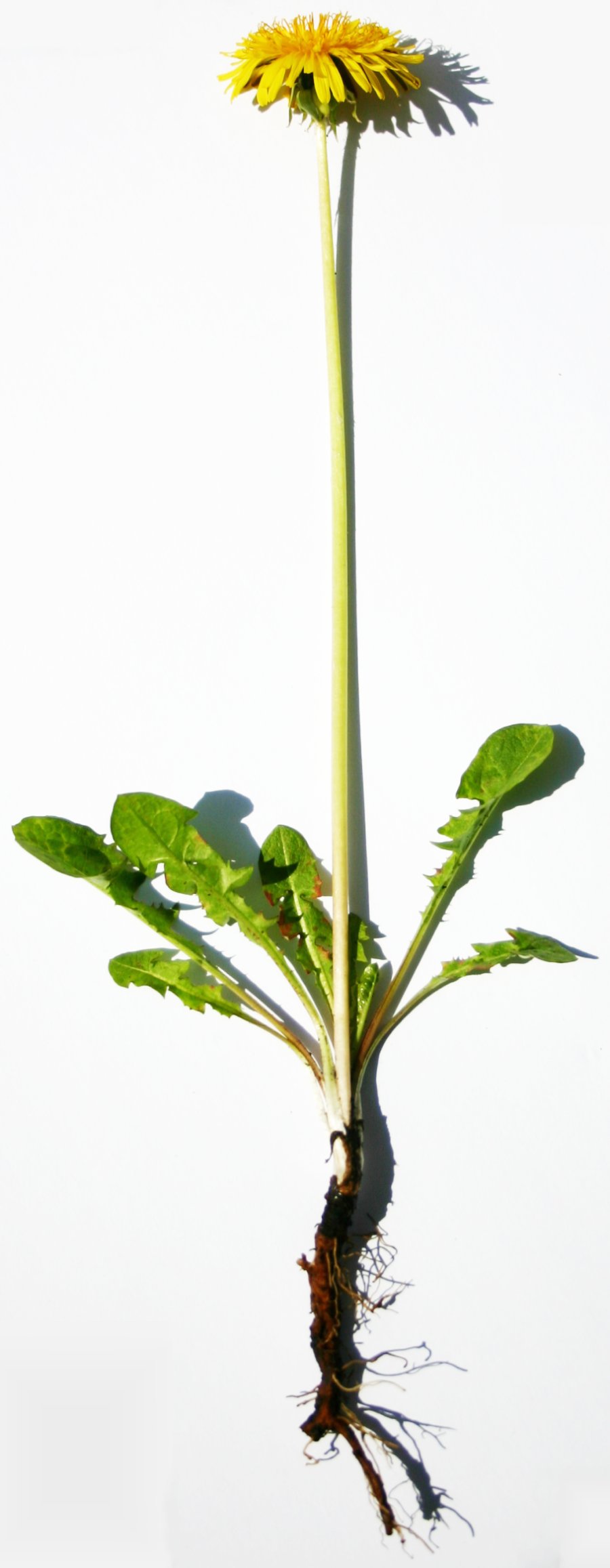
True
Dandelion (Taraxacum officinale): Perennial, frequent throughout
Ireland. Dandelions
are best distinguished by a combination of: basal (rosette) leaves
only – which are hairless and (usually) tooth-lobed; undivided
flowering stems with no bracts or leaves – the stems being both
hollow and latex containing; flowers contain ray florets only
without red colouration – the sepals have the same lenght with
bracts forming a ring around the base. The entire plant is usually
hairless and usually bitter tasting. Dandelions have many edible and
medicinal uses, see Plant For A Future page for more details: PFAF.
Apparently there are up to 250 varieties/species belonging to 9
sections to be found (at least in the UK, 8 sections are found in
Ireland), but being very similar they need an expert to distinguish.
The significance of this is that it is, in theory, possible to find
a dandelion flowering at any time of the year (however any given
plant does not flower all year around!). More information on this at
WildFlowerFinder.
Glossary
Ray Florets: "(in a composite flowerhead of the daisy family) Any of a number of strap-shaped and typically sterile florets that form the ray. In plants such as dandelions, the flowerhead is composed entirely of ray florets" – The Free Dictionary.com
Disk Florets: "(in a composite flowerhead of the daisy family) Any of a number of small, tubular, and usually fertile florets that form the disk. In rayless plants such as the tansy, the flowerhead is composed entirely of disk florets" – The Free Dictionary.com
Fluted Stem: Deep ridges and furrows running vertically up the stem.
Fasciation: where the normal flower development is interrupted (can be due to either a mutation, infection, herbicide use etc.) and so the flower develops in an oval form, or maybe as a double head. This is possible in many flowers, but common only in a few (such as Dandelion, Willow and Foxglove).
Ray Florets: "(in a composite flowerhead of the daisy family) Any of a number of strap-shaped and typically sterile florets that form the ray. In plants such as dandelions, the flowerhead is composed entirely of ray florets" – The Free Dictionary.com
Disk Florets: "(in a composite flowerhead of the daisy family) Any of a number of small, tubular, and usually fertile florets that form the disk. In rayless plants such as the tansy, the flowerhead is composed entirely of disk florets" – The Free Dictionary.com
Fluted Stem: Deep ridges and furrows running vertically up the stem.
Fasciation: where the normal flower development is interrupted (can be due to either a mutation, infection, herbicide use etc.) and so the flower develops in an oval form, or maybe as a double head. This is possible in many flowers, but common only in a few (such as Dandelion, Willow and Foxglove).


